How to Interpret Dreams: Jung's Method
By Evgeny Smirnov, PhD · Psychological counsellor & founder of Individuate.me
How to interpret dreams in 4 steps with Jung's method: context, your associations, amplification and compensation, with one published dream worked through.
Here is how to interpret dreams with Carl Jung's own method: you start with your life and your associations, not with a symbol dictionary. I am Evgeny Smirnov, a psychological counsellor (MS in psychology; PhD in mathematics and physics) and the founder of Individuate.Me, and in this guide I quote Jung's own texts with paragraph numbers, so you can check every step yourself.
Short answer: To interpret a dream the way Jung did, work in 4 steps. (1) Write down the dream and what was going on in your life. (2) Collect your own associations to each image, staying close to the image. (3) Only then compare it with myths and common motifs. (4) Ask what one-sided conscious attitude the dream compensates. Jung called every interpretation 'an hypothesis' (CW 16, §322). Individuate.Me's Step-by-Step Analysis (the guided mode) follows the same order.
Jung citations refer to the Collected Works (CW): volume 8, The Structure and Dynamics of the Psyche, and volume 16, The Practice of Psychotherapy. The sign § marks a paragraph number, not a page.
1. How did Jung interpret dreams? Jungian dream analysis in brief
Jung interpreted a dream by first collecting its context (the dreamer's life situation and the dreamer's own associations to every image) and only then asking what the dream adds to the dreamer's conscious view. He did not use a fixed list of symbol meanings, and he did not think a dream hides its meaning behind a mask: 'The "manifest" dream-picture is the dream itself and contains the whole meaning of the dream' (CW 16, §319).
Is this a proven method? No. Even when putting forward his compensation theory, Jung did not wish 'to assert that this is the only possible theory of dreams' (CW 8, §491). In Jungian psychology, the method is a clinical procedure, not a measured fact, and later research supports some parts of it and questions others. Roesler, summarizing his Structural Dream Analysis studies in the Journal of Analytical Psychology, reports results that 'support Jung's theory of the dream as a self-representation of the psyche and his concept of interpretation at the subjective level', yet adds that 'it could be questioned that the dream has a compensating function' (Roesler, 2025).
Dive Deeper: Which of Jung's ideas hold up, and which do not? Read what research says about Jungian psychology.
Key terms
- Context: the dreamer's life situation at the time of the dream, and the associations around each single image (CW 16, §§319-321).
- Association: what an image means to you personally: where you met it, what it reminds you of.
- Free association: following a chain of thoughts away from the image. Jung rejected it for dreams (CW 16, §320).
- Amplification: comparing a dream image with parallels from myth, religion, fairy tales and culture.
- Compensation: in Jung's words, 'balancing and comparing different data or points of view so as to produce an adjustment or a rectification' (CW 8, §545).
- Subjective and objective level: reading a dream figure as a part of yourself, or as the real person it resembles (CW 8, §§509-510).
The four steps at a glance
| Step | The question you ask | Where Jung says it | What Individuate.Me's guided mode does |
|---|---|---|---|
| 1. Context | What was going on in my life? | CW 8, §477; CW 16, §334 | Records the dream in your words and asks what was going on in your life around that time |
| 2. Associations | What does this image mean to me? | CW 16, §§319-321 | Lists objects and characters without meanings, then asks for your associations, close to each image |
| 3. Amplification | Does a myth or a common motif echo it? | Only after the context is complete (CW 16, §321) | Uses personal, cultural, archetypal and natural levels in the reading |
| 4. Compensation | What does the dream add to my conscious attitude? | CW 8, §§545-546; CW 16, §334 | Considers what the waking ego is not seeing |
2. Step 1: What was going on in your life when you had the dream?
Write the dream down in your own words and add a few lines about what was happening in your waking life at the time, because Jung held that a dream cannot be read without this. 'If we want to interpret a dream correctly, we need a thorough knowledge of the conscious situation at that moment' (CW 8, §477). Elsewhere he is even more direct: 'without knowledge of the conscious situation the dream can never be interpreted with any degree of certainty' (CW 16, §334).
Why does the life situation matter so much? Because, for Jung, a dream answers something. A hypothetical locked door can mean one thing in the week you were refused a job and another in the week you avoided a difficult conversation. Since an interpreter never knows your conscious situation for certain, 'dream-interpretation is naturally impossible without questioning the dreamer' (CW 8, §546).
In practice, Step 1 is two short notes:
- The dream itself, written as soon as you can, without editing out the strange or embarrassing details. Include feelings, colors and anything that was missing.
- The context: three or four lines about what occupied you in the days before (conflicts, decisions, worries, hopes).
Jung urged his patients to keep 'a careful record of their dreams and of the interpretations given' (CW 16, §322). For a routine, see how to keep a dream journal.
Individuate.Me's guided mode starts exactly here. Its first stage records the dream close to your own words and asks: 'Can you tell me briefly what was going on in your life around the time of this dream?' If you prefer not to answer, it does not insist.
3. Step 2: What does each image mean to you?
First make a short inventory of the dream: the objects and characters, anything that was strikingly absent, and what your dream self did. Then take each image in turn (every place, object, person and animal) and write what it means to you and where it appears in your life, staying with the image rather than drifting away from it. This step separates Jungian dream interpretation from a dictionary lookup, and Jung was strict about it:
When we take up an obscure dream, our first task is not to understand and interpret, but to establish the context with minute care. By this I do not mean unlimited 'free association' starting from any and every image in the dream, but a careful and conscious illumination of the interconnected associations objectively grouped round particular images. (CW 16, §319)
He says the same in 'On the Nature of Dreams': interpretation begins by 'taking up the context', which is 'determined by the associations of the dreamer himself', and 'stereotyped interpretation of dream-motifs is to be avoided' (CW 8, §§542-543).
Why not free association? 'Free association will bring out all my complexes, but hardly ever the meaning of a dream. To understand the dream's meaning I must stick as close as possible to the dream images' (CW 16, §320). A chain of associations always leads somewhere emotional, but it would get there from a newspaper headline too. (On complexes, see how complexes show up in dreams.)
His practical trick is worth stealing. If a dreamer associates a 'deal table' (a table of plain softwood) only with his writing desk, which is not made of deal, Jung keeps returning to the image: 'Suppose I had no idea what the words "deal table" mean. Describe this object and give me its history in such a way that I cannot fail to understand what sort of a thing it is' (CW 16, §320). Try it: describe each image to an imaginary person who has never seen one. If nothing comes to mind, note that too. For Jung, such a blank 'is itself significant' (§320). Only when this is done for all the images 'we are ready for the venture of interpretation' (§321).
The guided mode follows the same rule. Its association stage asks 'Where has [this image] appeared in your life?' and, for people, 'What quality do they embody for you?'. It does not ask for associations to associations: if a room reminds you of your grandmother's kitchen, it records that and stops there.
What about the people in your dream?
People need one extra question: is the dream about this person, or about a part of you? Jung called the second reading 'interpretation on the subjective level' (CW 8, §509), and I cover how to choose between the two in what it means when you dream about someone and in a short Substack guide to choosing between subjective and objective interpretation.
4. Step 3: When should you look at myths and symbols?
Look at myths, fairy tales and common motifs only after your personal associations are on paper, and only for the images that stay obscure. This comparison is called amplification: it widens an image with parallels the dreamer may not know, but it comes after the personal context, not instead of it. I describe how Jung did it, with his own example, in how Jungian amplification works.
Why does the order matter? Because a ready-made symbol meaning easily overwrites what the image means to you: in Roesler's dream series a snake threatened one dreamer and helped another (Roesler, 2020), as I show in whether dream dictionaries work.
So use motif lists as a map of possibilities, not as answers. Being chased and falling are typical motifs, counted with the research behind them in the most common dream motifs. Roesler's structural patterns (a threatened dream ego, performance, mobility and so on) belong here too, as general knowledge rather than personal meaning: his current typology has six patterns, and with it he could categorize 'more than 90% of the dreams in the study' (15 therapy cases, 206 dreams) (Roesler, 2025). The question in Step 3 is always: which parallel fits what you wrote in Step 2?
Sometimes an image resists explanation: it keeps returning, it feels charged, and every reading seems too small. For such images Jung used a different technique, in which you stay with the image and let it continue while awake. See active imagination as a method.
5. Step 4: What is the dream compensating for?
Ask what conscious attitude the dream balances or corrects. This was Jung's own heuristic rule: 'in interpreting a dream, to ask myself: What conscious attitude does it compensate?' (CW 16, §334). Compensation is the center of Jungian dream analysis, and also the place where care is needed most.
Jung separated compensation from a simple complement, which fills a gap 'more or less mechanically' (CW 8, §545). He then described three possibilities (CW 8, §546):
- If your conscious attitude is strongly one-sided, the dream takes the opposite side.
- If your attitude is 'fairly near the "middle"', the dream offers variations.
- If your attitude is adequate, the dream coincides with it and emphasizes it.
The more one-sided the attitude, the more likely vivid dreams with a strongly contrasting content become (CW 8, §488). However, compensation is individual: a pessimist does not necessarily get cheerful dreams, and depending on his nature 'his dreams will purposively assume a much blacker character than his conscious attitude' (§489). Hence, Jung admits, it is 'not easy to lay down any special rules' (§490).
His clearest example is a young man who dreamed that his father drove his new car clumsily into a wall and turned out to be 'dead drunk' (CW 16, §335). In waking life the son admired his father and was convinced his father would never behave like that. Was the good relation only on the surface? Jung found 'nothing neurotically ambivalent' in it (§335). The unconscious was 'trying to take the father down a peg', because the son's relation to his father was 'not only good, but actually too good' (§336).
An honest caveat: compensation is a theory, and not the only one. Roesler calls the continuity hypothesis, which links dream content closely to waking life, 'the most prominent theory in dream research today', and, based on his own data, suggests the function of dreams 'could be called not so much compensating, but more confronting consciousness with the actual reality of the psychological situation' (Roesler, 2025). Earlier he was even blunter: 'there is no real evidence for a compensating activity in dreams, as Jung claims' (Roesler, 2020). He sees 'more evidence for Jung's first theory, that the dream presents a more holistic picture of the total situation of the psyche', and in that sense the function of dreams 'could be called not so much compensating, but more of completing the picture by adding aspects that are not accessible for waking life consciousness'. So in Step 4 I ask two questions: what might the dream correct, and what does it simply show as it is?
6. One dream, worked from start to finish
The clearest complete example is a dream Jung published in 'General Aspects of Dream Psychology' (CW 8, §§478-482). It contains everything the method needs: the dream, the dreamer's own associations, the life context and Jung's reading.
The dreamer came for a first consultation. He said he was in the best of health, not a patient in any sense, and interested in analysis 'from a literary point of view'. The night before the visit he dreamed:
I was in a bare room. A sort of nurse received me, and wanted me to sit at a table on which stood a bottle of fermented milk, which I was supposed to drink. I wanted to go to Dr. Jung, but the nurse told me that I was in a hospital and that Dr. Jung had no time to receive me. (CW 8, §478)
| Step | What we learn | Source |
|---|---|---|
| 1. Context | The dream came the night before a visit the man presented as purely intellectual. | CW 8, §478 |
| 2. Associations | Bare room: 'A sort of frosty reception room, as in an official building, or the waiting-room in a hospital. I was never in a hospital as a patient.' Nurse: repulsive, cross-eyed, reminded him of a fortune-teller and palmist he once visited. Fermented milk: 'nauseating'; his wife drinks it for her health and he makes fun of her; he once had to drink it in a sanatorium, when his nerves 'were not so good'. | CW 8, §479 |
| 1 again | Jung asked whether that nervous trouble had gone. It had not, and his wife had long been urging him to consult Jung. | CW 8, §480 |
| 3. Amplification | Barely needed. The fortune-teller association shows how he imagined Jung's work. | CW 8, §481 |
| 4. Compensation | He came 'in the guise of a philosopher and psychologist' and pushed his trouble into the background. The dream puts him in a hospital and hands him the drink he finds nauseating. | CW 8, §481 |
Jung's conclusion: 'He has to swallow this bitter drink' (§481), and 'The dream rectifies the situation. It contributes the material that was lacking and thereby improves the patient's attitude' (§482).
Three things are worth noticing. Firstly, no dictionary entry for 'fermented milk' could produce a sanatorium where his nerves were not so good. Only the dreamer had that. Secondly, the decisive context came out of the associations themselves, which is why Steps 1 and 2 run together in real work. Thirdly, Jung warns that 'certainly not in all dreams is the compensatory function so clear as in this example' (CW 8, §483).
Try the four steps on your own dream
Open the app, choose Step-by-Step Analysis and write your dream: you add your context and associations before any interpretation.
7. How do you know a reading fits?
In Jung's practice, a reading fits when the dreamer recognizes it after thinking it through, not when the interpreter is convinced. His rule was to 'consider every dream interpretation invalid until such time as a formula is found which wins the assent of the patient' (CW 16, §316); understanding should be 'an agreement which is the fruit of joint reflection' (§314). The father dream passed this test: the reading 'struck home. It won the spontaneous assent of the dreamer' (§337).
However, assent is a clinical criterion, not a validity test. A reading can feel right simply because it is vague enough to fit anyone; psychologists call this the Barnum effect, which I discuss in why dream dictionaries feel accurate. Jung's second check was time: 'A relative degree of certainty is reached only in the interpretation of a series of dreams, where the later dreams correct the mistakes we have made in handling those that went before' (CW 16, §322). That is why recurring dreams and dream series tell you more than a single dream.
A checklist before you accept any interpretation, your own included:
- Is it built from your associations? If it would fit anyone's dream with the same image, it is a dictionary entry.
- Does it tell you something new? Jung assumed a dream adds 'something important to our conscious knowledge', and admitted that this, 'too, is a theory' (CW 16, §318).
- Did you agree after reflection, or because it sounded authoritative? A reading pushed by the interpreter's theory convinces mainly by suggestion (CW 16, §315).
- Does it survive your next dreams? Look at it again after a few weeks (CW 16, §322).
- Does it leave your values intact? Jung insisted 'that no real values of the conscious personality should be damaged' (CW 16, §338).
8. Can an app or ChatGPT do Jungian dream analysis for you?
An AI can follow the same four steps only if you give it the same material, because it cannot know your life or your associations unless you write them down. Even with that material, ChatGPT's single reply scored lower on exploration-insight in a 2026 study by Blagrove and colleagues than dream groups had scored in three earlier studies; I go through this study and my own unpublished one, with their limits, in whether ChatGPT can interpret dreams.
Individuate.Me, the app I built, splits the work in two:
- Quick Interpretation: you paste a dream and get a Jungian reading at once. Its instructions state that it works without your personal associations, so treat it as a first draft.
- Step-by-Step Analysis (the guided mode): four stages that mirror this article. It collects the dream and your life context, identifies objects and characters without assigning meanings, asks for your associations, and only then interprets, including the compensation question.
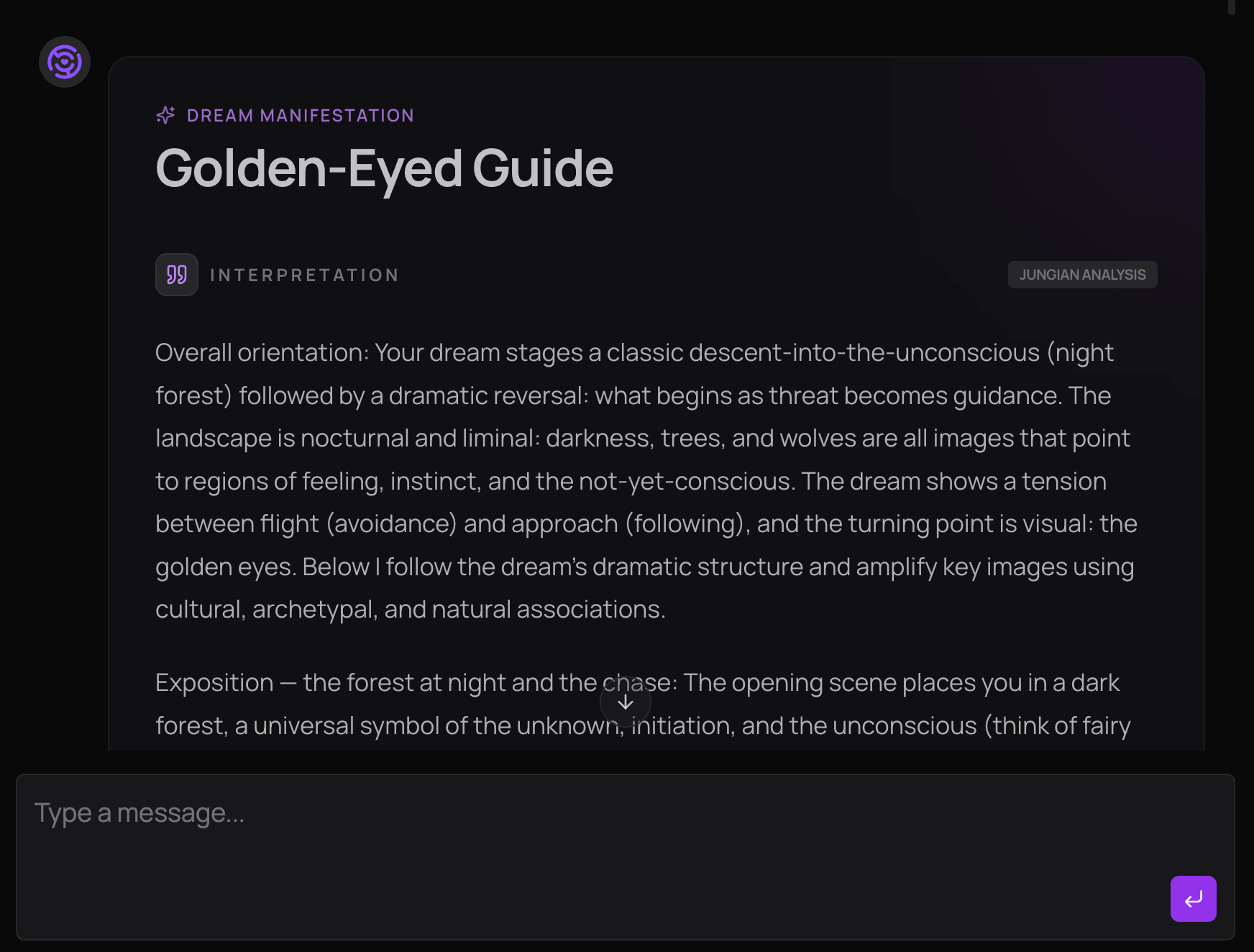
A quick interpretation of a demo dream (demo account, not a user's dream). The guided mode adds the association stage before a reading like this.
As of November 2026, credits are pay-as-you-go: Starter is $1 for 100 credits (the site estimates about 5 dreams), with no subscription, and credits do not expire. See current credit packages and prices.
9. What are the common mistakes in interpreting dreams?
The common mistakes in interpreting dreams each break one of the four steps: a dictionary meaning first, free association, a single level of reading, forced archetypes and certainty from one dream. I go through each of them, with examples, in common mistakes in dream interpretation.
10. When don't you need to interpret a dream?
You do not need to interpret every dream. If a dream left no feeling and does not come back to you during the day, writing it down is enough; Jung himself wrote that 'an obscure dream, taken in isolation, can hardly ever be interpreted with any certainty' (CW 16, §322).
Interpretation is also the wrong tool in a few situations, whoever offers it:
- If you need better sleep, not meaning. Frequent nightmares that wake you up, or sleep that leaves you exhausted, are a question for a doctor or a sleep specialist first.
- If dreams replay a traumatic event. Trauma work belongs with a licensed professional, not with a book or an app.
- If you are in distress. This article and Individuate.Me are not therapy. They do not diagnose anything and are no substitute for professional care. If dreams come with anxiety or low mood that affects your daily life, please talk to a licensed mental health professional.
- If you want Jungian work with a person. Look for a certified Jungian analyst: the International Association for Analytical Psychology has a public member search, and there is the C.G. Jung Foundation for Analytical Psychology in New York.
Frequently asked questions
How do I find out what my dream means?
Write the dream down with what was going on in your life at the time. Note your own associations to each image, staying close to the image. Compare it with myths or common motifs only where your associations run out. Then ask what the dream adds to your conscious view. Jung treated the result as a hypothesis that later dreams can correct (CW 16, §322).
What is Carl Jung's method for interpreting dreams?
Jung first established the context: the dreamer's life situation and the dreamer's associations to each image, without free association (CW 16, §§319-321). Where needed, he amplified images with parallels from myth and culture. Then he asked his heuristic question: what conscious attitude does the dream compensate? (CW 16, §334).
How do I know if a dream interpretation is right?
Jung considered every interpretation invalid until it won the assent of the dreamer (CW 16, §316) and checked it against later dreams in a series (§322). Assent is not proof: a vague reading can feel right to anyone. A useful reading is built from your associations and tells you something you did not already think.
Can AI interpret my dream?
Only if you give it your waking context and your associations. Even then, ChatGPT's single reply scored lower on exploration-insight in a 2026 study by Blagrove and colleagues than dream groups had scored in three earlier studies (see whether ChatGPT can interpret dreams). Individuate.Me's Step-by-Step Analysis (the guided mode) asks for your associations before it interprets anything. It is not therapy.
When should I talk to a professional about my dreams?
If your dreams come with distress that affects your sleep or daily life, or bring back a traumatic experience, talk to a licensed mental health professional. Dream interpretation, from a book, an app or this article, is not therapy. For Jungian work specifically, the International Association for Analytical Psychology (IAAP) has a public search of its members.
To sum up: context first, your associations second, myths third, compensation last, and every reading held as a hypothesis. What I value in this method is that the dreamer, not the interpreter, stays the final judge.
Try the guided mode on your own dream
Four stages: your dream and context, its images, your associations, then a Jungian reading. Starter is $1 for 100 credits, no subscription.
Share this article: